
A Lived-In Language
The government tried to erase this language. Its speakers are still coining words.

The Brief
The Chinuk Wawa greeting ɬax̣ayam literally means 'poor.' I think that etymology tells you something about the people who kept saying it, even when saying it could get them punished. About 500 people speak Chinuk Wawa conversationally now, and they're still making new words.
- What does the Chinuk Wawa greeting ɬax̣ayam mean?
- ɬax̣ayam is the standard Chinuk Wawa greeting. Linguist David Robertson traces it to Lower Chinookan lax̣awyam, meaning 'one's poverty' or 'poor.' The etymology carries an undertone of humility, like you're placing yourself below the person you're welcoming.
- What is the Chachalu Museum in Grand Ronde, Oregon?
- Chachalu is a cultural center operated by the Confederated Tribes of Grand Ronde. The name comes from Yamhill Kalapuya meaning 'place of the burnt timbers.' Its Cintutac Gallery takes its name from the Yamhill word for 'to find or recover something that was thought to be lost.'
- How can I study Chinuk Wawa for college credit?
- Lane Community College offers a two-year credited Chinuk Wawa program with six courses that satisfy World Language requirements across the Oregon University System. The program started in 2006 in collaboration with Grand Ronde and covers language, Indigenous culture, and community events.
- What is Nsayka Wawa?
- Nsayka Wawa is an interactive fiction module that teaches Chinuk Wawa through play and narrative context rather than word lists. Built by Odyssey Alive, it mirrors how the language was historically learned through trade and daily life. Betas open October 12th.
- Why did Chinuk Wawa nearly disappear?
- Boarding schools pulled children from their families and punished them for speaking their own languages, including Chinuk Wawa. Nearly 1,000 documented Native child deaths resulted from the boarding school system. The language survived because people kept speaking it, and about 500 speakers are still growing that number.
I was talking with Mary McGinnis, a council member from Rockaway Beach, Oregon. She'd visited the Chachalu Museum in Grand Ronde and told me she and her companions "felt like they were treated like royalty." She couldn't put her finger on why.
I've been to the Chachalu many times. It sits in the foothills of the Coast Range, surrounded by Douglas fir and the kind of quiet that makes you lower your voice without deciding to. I think I know why she felt that way. It starts with the word they use to greet you when you walk in.
ɬax̣ayam.
A Word That Bows
In Chinuk Wawa, ɬax̣ayam is the standard greeting. Linguist David Robertson traces it to Lower Chinookan lax̣awyam, meaning "one's poverty."1 The literal translation is something close to "my poorness" or "my pitifulness." But it's a greeting of humility. The speaker places themselves below the person they're welcoming. Not "I'm here and I see you." The word bows so the visitor stands taller.
I think about that every time I walk through the Chachalu doors. And they still say it at the front desk, because the language is lived in and carries weight.
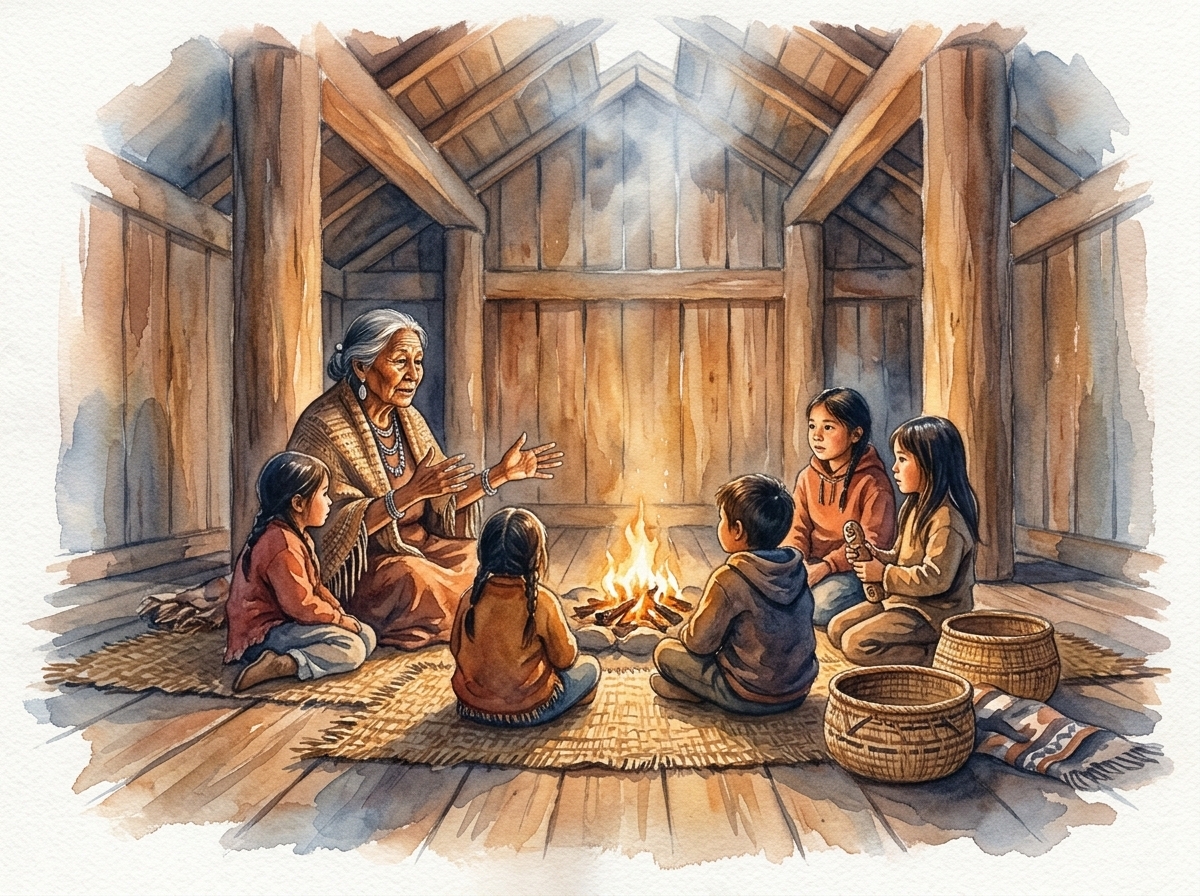 A language lives in rooms like this, between people who still speak it.
What Nearly Killed It
A word like ɬax̣ayam survived because people kept speaking it even when speaking it could get you punished. I've sat with that fact at the Chachalu more than once. It lands harder every time.
In the mid-1800s, the federal government forced more than thirty tribes onto the Grand Ronde reservation. Different nations, different languages, different histories. Necessity made Chinuk Wawa the common tongue. And then the government decided to suppress the very languages it had inadvertently pushed together. Boarding schools pulled children from their families and punished them for speaking their own languages, including Chinuk Wawa.2 Nearly 1,000 documented Native child deaths resulted from the boarding school system. President Biden formally apologized in 2024.
"If you don't have language, you don't have culture." That's Justine Flynn, who works with the Grand Ronde language programs.3 She's being precise. The boarding schools understood that relationship perfectly. Suppressing the language was never a side effect. It was the mechanism.
What's Growing Back
About 500 people speak Chinuk Wawa conversationally, and that number is growing.3 Grand Ronde runs immersion programs for children. Speakers are still coining new words. Lima-tintin means cell phone. Literally, "hand ringing." I love that one.
This part gets me. You can study Chinuk Wawa for college credit. Lane Community College's Chinuk Wawa program offers six courses over two years that satisfy World Language requirements across the Oregon University System. The program started in 2006 in collaboration with Grand Ronde, and the curriculum covers language, Indigenous culture, community events, and a connection to the people and landscape the words come from. Most language requirements point you toward a culture on the other side of a plane ticket. This one is in the Willamette Valley.
Lane Community CollegeTwo-Year Chinuk Wawa ProgramSix credited courses that satisfy World Language requirements. Language, culture, community, and hands-on practice.David G. Lewis, a Grand Ronde tribal member and historian, has written about how anthropologists assumed tribes stayed close to their villages and didn't build trade networks. But Chinuk Wawa pulls vocabulary from Chinookan, Nootkan, Salishan, French, and English. Some scholars "theorized that Indians could not have developed such a trade jargon or the trade network it implied."4 A language with words from three continents, and the academic response was to doubt it could exist.
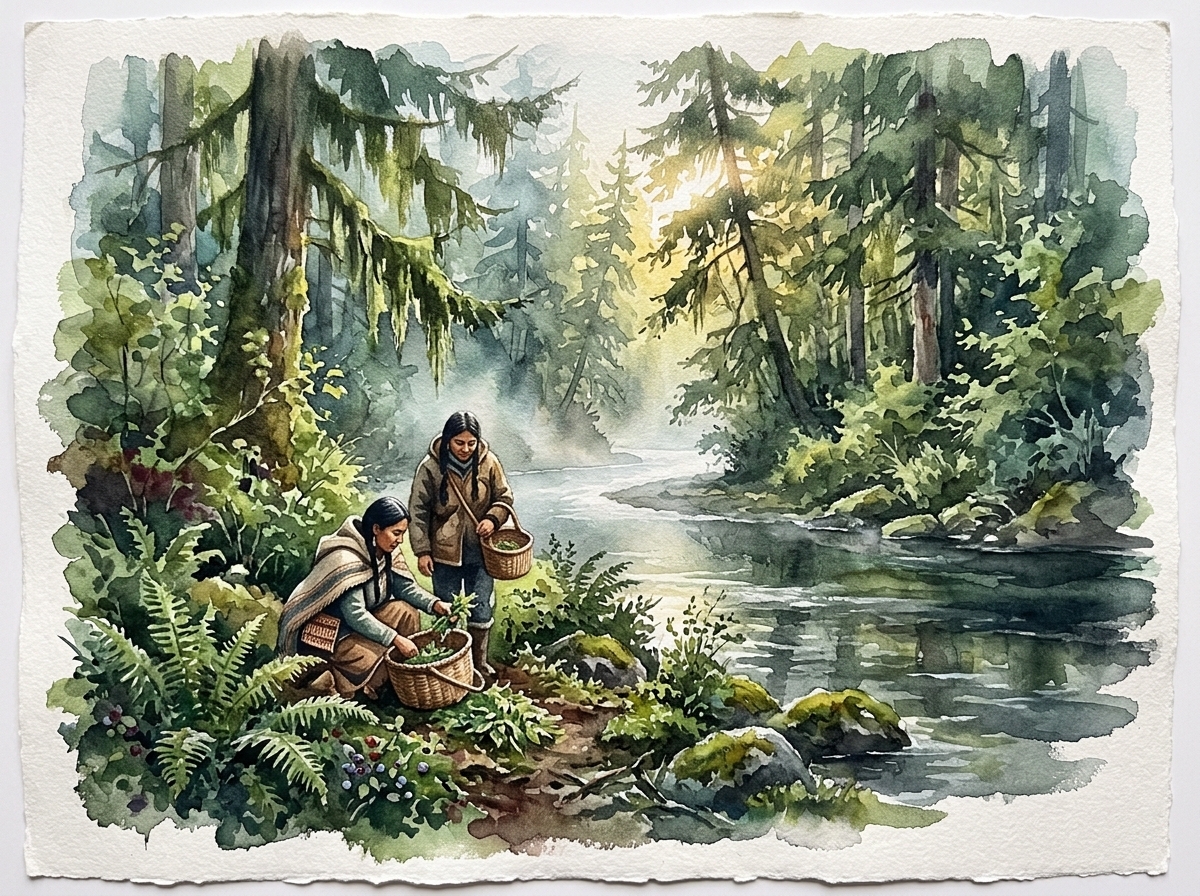 Five hundred speakers and a vocabulary still growing. The language outlasted the policy that tried to end it.
A Lived-In Language
I'm building something that comes from all of this. Nsayka Wawa is an interactive fiction module that teaches Chinuk Wawa through play and narrative context. You learn it the way people always learned it, by using it. Betas open October 12th.
Coming October 12Nsayka Wawa: Learn Chinuk Wawa Through PlayAn interactive fiction module that teaches the language through play and story. Sign up for the beta.And if you're anywhere near Grand Ronde, visit the Chachalu Museum. The name means "place of the burnt timbers" in Yamhill Kalapuya. Inside, you'll find the Cintutac Gallery. Cintutac is Yamhill for "to find or recover something that was thought to be lost."5
That council member from Rockaway Beach was right. She was treated like royalty. She just didn't know it was one word doing all the work. ɬax̣ayam. A greeting that places the recipient above the speaker, in a language still coining words for things that didn't exist when the first speakers started talking.
References
Footnotes
-
Robertson, David (2019). "Klahowya from the Strait of Juan de Fuca." chinookjargon.com. chinookjargon.com ↩
-
Caldbick, John (2024). "Chinook Jargon (Chinuk Wawa)." HistoryLink.org Essay 23036. HistoryLink.org ↩
-
"Seattle's Historic Chinook Jargon Is Having a Moment." Seattle Met, April 2025. Seattle Met ↩ ↩2
-
Lewis, David G. (2016). "Outside the Ethnographic Box: Native Trade Networks." The Quartux Journal. The Quartux Journal ↩
-
"About Chachalu." Confederated Tribes of Grand Ronde. chachalu.org ↩
More to Explore

How AI Hacks Humans
Google changes your settings every week. So when a scam asked a specialist to log in and change one, it sounded like work.

The Endorsement
The government banned Anthropic's AI for being too dangerous. Every competitor's model is still running. That's not the compliment it sounds like for the competition.

Two Brains: Why Dynamic Model Routing Beats Picking One AI
The better your coding model gets at code, the worse it writes. I stopped picking favorites and started switching between them.
Browse the Archive
Explore all articles by date, filter by category, or search for specific topics.
Open Field Journal