
Fieldwork in Plain Earshot
A trade language carried evidence of multi-sited fieldwork across the Pacific Coast for centuries. Anthropology just hadn't arrived to notice.

The Brief
Chinuk Wawa, the Pacific Northwest trade language, contains words from Chinookan, Nootkan, Salishan, French, and English, making its vocabulary a record of multi-sited contact that predates formal anthropological fieldwork by centuries. Its openness preserved creation stories not through gatekeeping but through reach.
- What is Chinuk Wawa?
- Chinuk Wawa is a trade language of the Pacific Northwest that drew vocabulary from Chinookan, Nootkan, Salishan, French, English, and other language families. At its peak around 1900, roughly 250,000 people spoke it. The Confederated Tribes of Grand Ronde maintain it through immersion programs and courses, with about 500 conversational speakers.
- How does Chinuk Wawa relate to multi-sited ethnography?
- Anthropologist George Marcus coined 'multi-sited ethnography' in 1995 to describe fieldwork spanning multiple locations. Chinuk Wawa's vocabulary already mapped trade networks across three thousand miles of coastline and multiple continents, recording who met whom and where, centuries before the discipline formalized the concept.
- What is Nsayka Wawa?
- Nsayka Wawa is an interactive fiction module that teaches Chinuk Wawa through play and context rather than word lists and drills. It mirrors how the language was historically learned, through trade, household life, and riverbank encounters rather than classroom study.
- Why did Chinuk Wawa nearly disappear?
- After the federal government forced over thirty tribes onto the Grand Ronde reservation in the 1850s, Chinuk Wawa creolized into a first language for children. Boarding schools then forbade Native languages and punished children for speaking them. The language survived through community transmission and is being revitalized through immersion programs.
I've been staring at a vocabulary list for months now. Not the kind you'd find in a textbook. This one was assembled over centuries by traders, Metis families, missionaries, and at least a dozen Indigenous nations along the Pacific Coast. Every word in Chinuk Wawa carries its own passport.
"Mamook" comes from Nootkan, a language spoken on Vancouver Island, more than 200 miles north of the Columbia River where most of the Jargon took shape. It means to make, to do, to work. "Leclem" comes from le creme, courtesy of French-speaking fur traders who married into Chinookan families and raised bilingual children at the mouth of the Columbia. "Kul-lagh" is the English word "corral," but with the R swapped for an L, because Chinookan speakers didn't use that sound.1
Three words. Three languages. Three continents. And that's before you get past the first page of the dictionary.
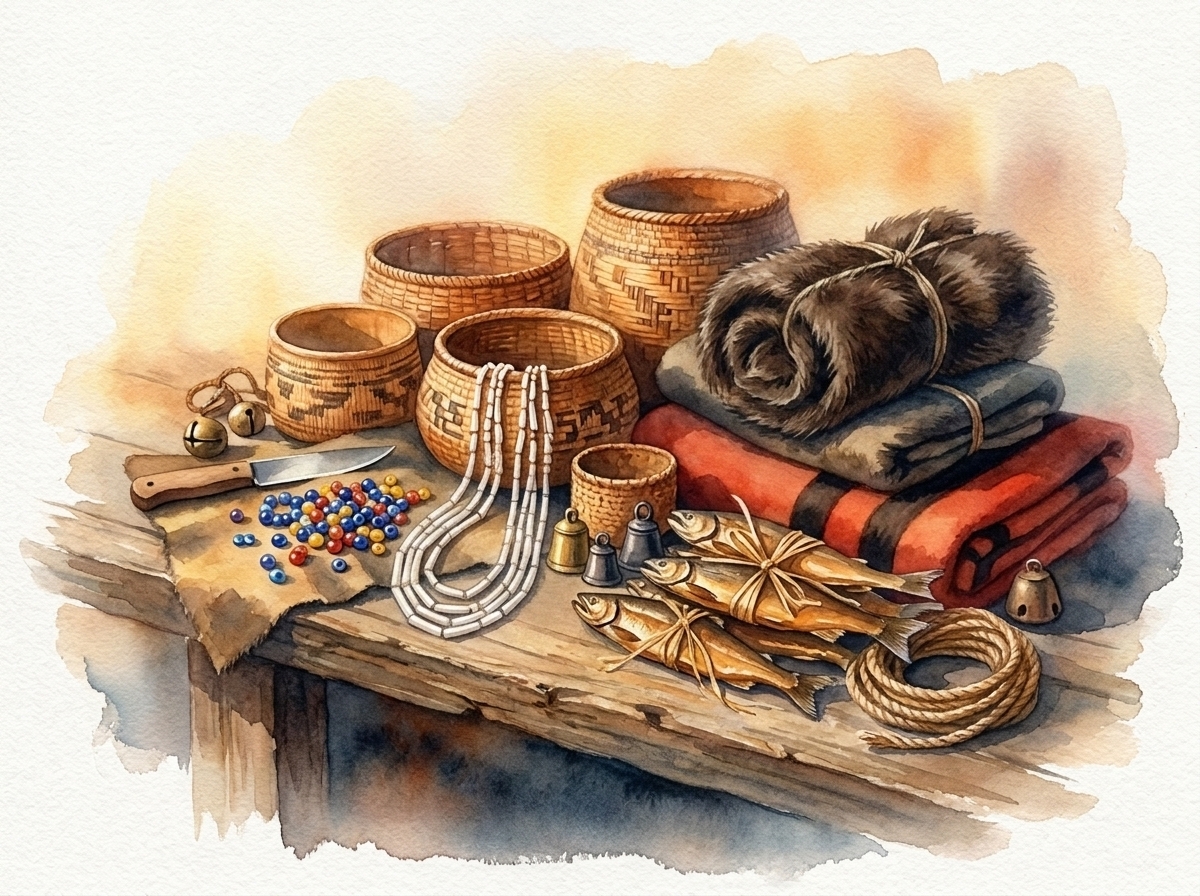 Dentalium from Vancouver Island, beads from Europe, salmon from the Columbia. Every item a customs stamp.
The Evidence Was in the Room
In 1995, anthropologist George Marcus coined the term "multi-sited ethnography" to describe fieldwork that follows people, things, or ideas across multiple locations instead of staying planted in one village with a notebook. The discipline had spent generations studying cultures as though they existed in isolation, each tribe in its own tidy frame.
But Chinuk Wawa had been sitting in plain earshot the whole time. It contains words from Chinookan, Nootkan, Salishan, French, English, and several other language families.2 Its vocabulary is a record of who met whom, where, and what they needed to say. The language itself was the field report. Nobody filed it.
David G. Lewis, PhD, a historian and Grand Ronde tribal member, puts it bluntly: anthropologists assumed that tribes stayed close to their villages and didn't travel much or trade extensively. "When presented with evidence of extensive trade, like the existence of Indian trade jargons," he writes, "many scholars theorized that Indians could not have developed such a trade jargon or the trade network it implied."3
We built an entire discipline around studying human cultures, then used it to argue those cultures couldn't have been all that complex.
The Open Channel
Chinuk Wawa wasn't just multi-sited. It was open by design.
Most knowledge systems guard their gates. Academic journals require subscriptions. Trade guilds keep their methods proprietary. Even languages can be guarded, and for reasons that deserve respect. But Chinuk Wawa went the other direction entirely. Carisa Chang, a Chinook tribal member and language teacher, puts it simply: it has "always been about communicating with other people, and so we will always teach it to anyone who wants to learn."4
That openness wasn't a weakness. It was the architecture.
At its peak around 1900, roughly 250,000 people spoke the Jargon. Indigenous, Chinese, Japanese, European, Hawaiian.1 Linguists would later classify it as a "dead language." A quarter million speakers, and someone declared it dead. It's worth asking who wasn't listening.
The creation stories Chinuk Wawa carried didn't degrade with use. They passed from generation to generation through this open channel and arrived intact. Not because anyone guarded them. Because every speaker became another witness. The more people who learned the Jargon, the more people who carried what it held.
I think about that when I hear the argument that openness dilutes, that the wider the audience the weaker the signal. A language spoken by anyone who showed up carried creation narratives unchanged across centuries. The preservation strategy wasn't restriction. It was reach.
From Trauma to Transmission
By the late 1850s, the federal government had pushed more than thirty tribes onto a single reservation at Grand Ronde, Oregon. Different homelands. Different languages. Different histories. Some had been at war with each other. They needed a way to talk.
They already had one.
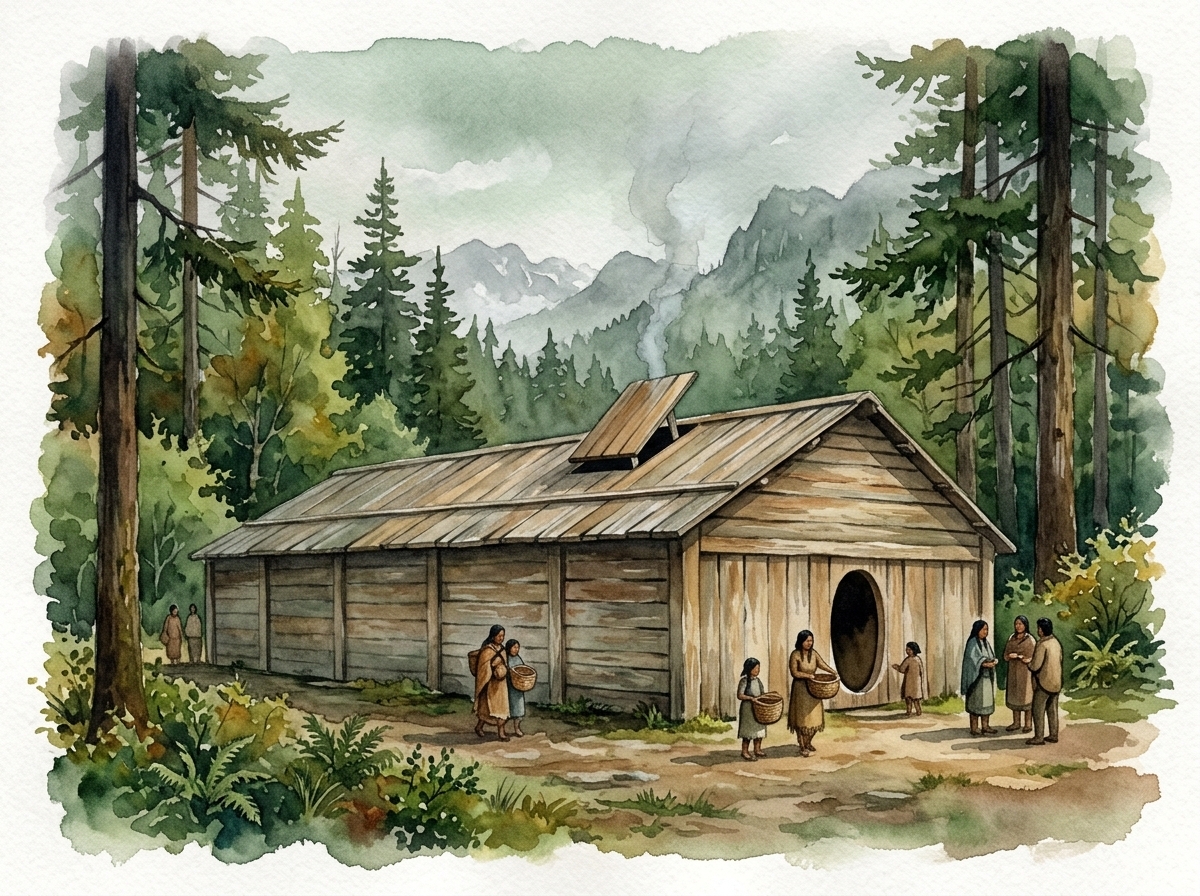 Thirty nations, one reservation. The lingua franca arrived before the soldiers did.
Chinuk Wawa became the common tongue at Grand Ronde, not by decree but by necessity. Justine Flynn, who runs the Shawash-ilihi Skul, the K-6 immersion school there, explains: "There was this need to settle in as a community and to create stronger ties, create unity. What came out of that was Chinook jargon being the common language."4
The Jargon creolized at Grand Ronde. It became a first language for children, spoken at home. Then the government, having accidentally created the conditions for a living language, tried to kill it too. Boarding schools forbade Native languages. Children were punished for speaking the tongue they'd grown up with.1
The language survived anyway. Grand Ronde now offers immersion programs for children. There's also a two-year online course through Lane Community College open to anyone and a growing community of about 500 conversational speakers. They're still coining new words. "Lima-tintin" means cell phone. Literally, "hand ringing."4
If you're an anthropology student staring down a language requirement, Lane Community College's Chinuk Wawa program offers six credited courses over two years that satisfy World Language requirements across the Oregon University System. Most language requirements point you toward a culture on the other side of a plane ticket. This one is in the Willamette Valley. The speakers, the stories, and the landscape they come from are all within driving distance.
Nsayka Wawa
I've been thinking about all of this because I'm building something.
Nsayka Wawa is an interactive fiction module that teaches Chinuk Wawa. It's going beta in a few weeks. The language arrives through play and context rather than word lists and drills. You explore a world and the language comes with it.
I chose interactive fiction because Chinuk Wawa was always experiential. You didn't study it in a classroom. You picked it up at the trading post, on the river, in the household where your mother spoke Chinookan and your father spoke French and the neighbors spoke Salishan. The language was the experience. The experience was the lesson.
 Nobody studied Chinuk Wawa for the credits. They learned it because the salmon were running.
The Field Report
In 1857, a historian credited "a shrewd Scotchman" with inventing the whole thing.1 The language contained words from more than a dozen sources spanning three thousand miles of coastline. One man.
The Jargon was never one person's invention. It was everyone's. And the evidence was always right there in the vocabulary. Reach. Complexity. Trade and kinship and marriage and mutual obligation. Every word a waypoint. Every sentence, a map of who had been where.
The fieldwork was already done. It was sitting in plain earshot the whole time.
References
Footnotes
-
Caldbick, John (2024). "Chinook Jargon (Chinuk Wawa)." HistoryLink.org Essay 23036. HistoryLink.org ↩ ↩2 ↩3 ↩4
-
Zenk, Henry. "Chinook Jargon (Chinuk Wawa)." Oregon Encyclopedia, updated September 25, 2024. Oregon Encyclopedia ↩
-
Lewis, David G. (2016). "Outside the Ethnographic Box: Native Trade Networks." The Quartux Journal. The Quartux Journal ↩
-
"Seattle's Historic Chinook Jargon Is Having a Moment." Seattle Met, April 21, 2025. Seattle Met ↩ ↩2 ↩3
More to Explore

The Endorsement
The government banned Anthropic's AI for being too dangerous. Every competitor's model is still running. That's not the compliment it sounds like for the competition.

Two Brains: Why Dynamic Model Routing Beats Picking One AI
The better your coding model gets at code, the worse it writes. I stopped picking favorites and started switching between them.

Will AI Stall Itself?
We call it the cloud. It is a windowless metal shed in the desert, and it is drinking the town's water. The thing most likely to slow AI down is not a smarter rival. It is the body AI runs on.
Browse the Archive
Explore all articles by date, filter by category, or search for specific topics.
Open Field Journal