
The Memory Famine
In November, analysts projected two percent smartphone growth. By February, they were forecasting the worst decline in history. The thing that changed wasn't demand.

The Brief
This article examines how AI data center expansion is consuming global DRAM supply, causing a projected 12.9 percent decline in smartphone shipments for 2026. It traces how China's rare earth export controls and the Strait of Hormuz crisis compound the shortage, while Apple's vertical supply chain integration positions it to weather pressure that smaller manufacturers cannot absorb.
- Why are smartphone prices rising in 2026?
- AI data centers operated by Amazon, Google, and Meta are consuming memory chip supply faster than manufacturers can expand capacity. Chip makers are prioritizing higher-margin data center orders over smartphone components, causing DRAM prices to nearly double and smartphone costs to reach record levels.
- How severe is the 2026 smartphone market decline?
- IDC projects a 12.9 percent decline in global smartphone shipments to 1.12 billion units, the lowest since 2013. Counterpoint Research calls it the sharpest decline on record. The sub-$100 smartphone segment representing 171 million devices may become permanently uneconomical.
- How do geopolitics affect the memory chip shortage?
- China's rare earth export controls have collapsed yttrium shipments to the US by 95 percent since April 2025, threatening materials needed for chip manufacturing. The March 2026 Strait of Hormuz closure threatens energy supplies to South Korea and Japan, where Samsung and SK Hynix manufacture most of the world's memory chips.
- Why is Apple less affected by the memory chip shortage?
- Apple spent fifteen years building vertical supply chain control, designing its own silicon and securing long-term memory supply agreements. This gives Apple stronger pricing power and supply chain integration compared to smaller Android manufacturers who treated hardware sourcing as commodity procurement.
Back in November, IDC put 2026 smartphone growth at two percent. The kind of number that doesn't make headlines. Three months later, the same firm revised it. Not two percent growth. A 12.9 percent decline.1 The sharpest drop in the history of the smartphone market.
I've watched forecasts long enough to know they drift. But this wasn't drift. Something changed between November and February, fast enough to flip an entire industry's outlook.
The something was a memory chip.
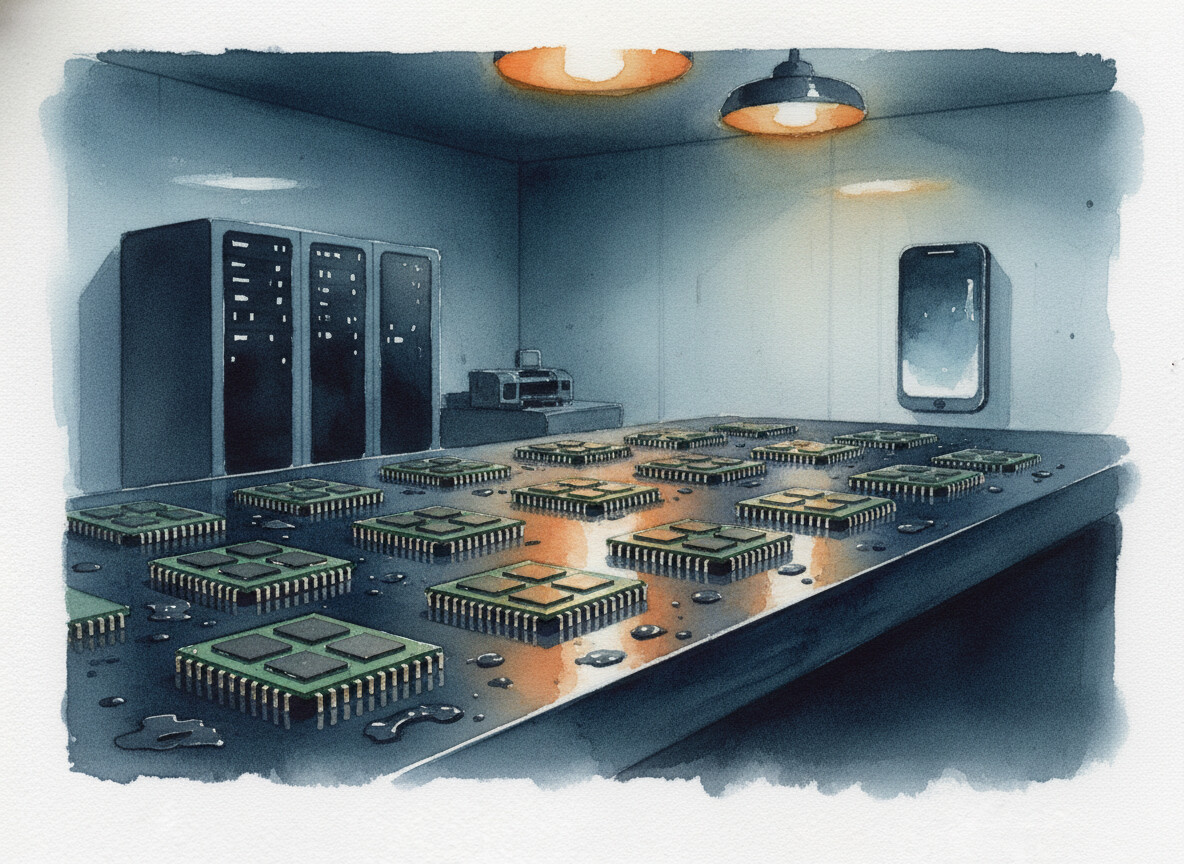 For years, DRAM was a quiet commodity. Then AI made it the most contested raw material in technology.
DRAM. The rapid-access memory that makes your phone responsive is the same component AI data centers need to think. Amazon, Google, Meta, and the other hyperscalers are building out AI infrastructure so fast they're consuming global memory supply before manufacturers can expand it. Counterpoint Research's Tarun Pathak said memory companies are telling phone makers to stand in line behind the data centers.2
IDC projects 2026 shipments falling to their lowest volume since 2013.1 And here's the one I circled. The sub-$100 smartphone, the device that connects 171 million people, is becoming what IDC's Nabila Popal called "permanently uneconomical."1 Not because anyone decided those people didn't matter. Because a data center offered more per chip.
And the squeeze isn't just about who gets the chips. It's about who controls what goes into making them. China produces over 90 percent of the world's processed rare earths, and since April 2025, Beijing has been tightening the tap. Yttrium exports to the U.S. collapsed 95 percent in eight months.3 Semiconductor makers are running low on scandium, which goes into every 5G smartphone and base station. One chokepoint feeds another.
Then, on March 1, the Strait of Hormuz effectively closed. South Korea imports nearly 70 percent of its oil through that strait. Samsung and SK Hynix, the companies that make most of the world's memory chips, watched their shares crash 10 and 11 percent in a single day.4 Semiconductor fabrication eats energy the way AI eats memory. When the energy supply is at risk, so is every chip coming off the line.
 Apple built its leverage fifteen years ago. Everyone else is building it now.
Not every phone maker is in the same position. Apple and Samsung spent years on vertical supply chain control, designing their own silicon and locking in long-term agreements. Counterpoint calls it "stronger supply chain integration, higher pricing power, and continued premiumization."2 The companies watching their margins disappear spent a decade competing on screen size and not one quarter asking where the memory came from.
Two industries are competing for the same chip. Neither knew it until now. One builds infrastructure for artificial intelligence. The other puts a computer in the pocket of five billion people. And now both are sitting inside a geopolitical standoff they didn't design and can't control.
IDC's earliest estimate for relief? Late 2027. If new manufacturing capacity comes online. If the rare earths ship. If the strait reopens. If no one else needs the chip by then.1
That November forecast still nags at me. Two percent growth. The analyst had every reason to believe it was right. Weeks later, the number flipped entirely. A single chip that everyone needed and no one could get enough of had rewritten the outlook for five billion phones.
References
Footnotes
-
Jeronimo, F. & Popal, N. (2026). "Worldwide Quarterly Mobile Phone Tracker." International Data Corporation. Reported in Reuters. ↩ ↩2 ↩3 ↩4
-
Pathak, T. (2026). "Global Smartphone Market Forecast." Counterpoint Research. Reported in CNBC. ↩ ↩2
-
Scheyder, E. & Lague, D. (2026). "Rare earth shortages worsen for US aerospace, chips despite trade truce." Reuters. ↩
-
MarketMinute. (2026). "Black Tuesday in Seoul: KOSPI Plummets 7% as War Fears and Semiconductor Slump Trigger Market Meltdown." FinancialContent. ↩
More to Explore

How AI Hacks Humans
Google changes your settings every week. So when a scam asked a specialist to log in and change one, it sounded like work.

A Lived-In Language
The government tried to erase this language. Its speakers are still coining words.

The Endorsement
The government banned Anthropic's AI for being too dangerous. Every competitor's model is still running. That's not the compliment it sounds like for the competition.
Browse the Archive
Explore all articles by date, filter by category, or search for specific topics.
Open Field Journal