
The Perfect Storm
Three forces are converging on the global workforce. Only one of them is artificial intelligence.

The Brief
Everyone's throwing around 'perfect storm' to describe the job market. I traced the phrase back to its meteorological roots and found the metaphor is more accurate than anyone realizes. Three forces are converging on the global workforce, and AI is only one of them.
- What is causing the 2025-2026 wave of global layoffs?
- Three forces are converging: economic pressure from tariffs and slow growth, companies cutting jobs in anticipation of AI rather than because of actual AI results, and a post-pandemic correction from years of overhiring. AI was directly cited in only 4.5 percent of the 1.2 million U.S. job cuts announced in 2025.
- Are companies actually replacing workers with AI?
- Mostly not yet. A Harvard Business Review survey of 1,006 global executives found sixty percent had reduced headcount in anticipation of AI, but only two percent had made large cuts based on what AI actually delivered. The cuts are running ahead of the technology.
- Which countries are hardest hit by AI-related job losses?
- The UK reported eight percent net job losses from AI over the past year, twice the international average, according to Morgan Stanley research. Major layoffs also hit Germany, the Netherlands, India, and Japan, with companies like Bosch, ASML, Tata Consultancy, and Nissan cutting thousands of positions.
- Why is the UK losing more jobs to AI than other countries?
- British companies saw nearly the same AI productivity gains as American ones, but the UK's surrounding economic conditions were worse: minimum wage increases, tax hikes, and sluggish growth made AI-driven cost cuts more attractive. The same technology produced different employment outcomes depending on economic pressure.
Have you ever noticed how a phrase can suddenly be everywhere? "Perfect storm." I've been hearing it in earnings calls, reading it in trade press, even picking it up in conversations with clients watching their teams shrink. The thing is, it gets tossed around so casually that I started wondering... does anyone actually know where it comes from?
I stumbled upon the answer in a story from 1991. A meteorologist named Bob Case was watching a storm build off the New England coast when he noticed something unusual. Three weather systems were converging on the same patch of ocean. One pulling warm air north, another dragging cold air south, and Hurricane Grace pumping tropical moisture right into the middle. Any one of them would've been a bad day at sea. Together, they built the storm that killed six fishermen. Years later, Sebastian Junger gave it a book title.1
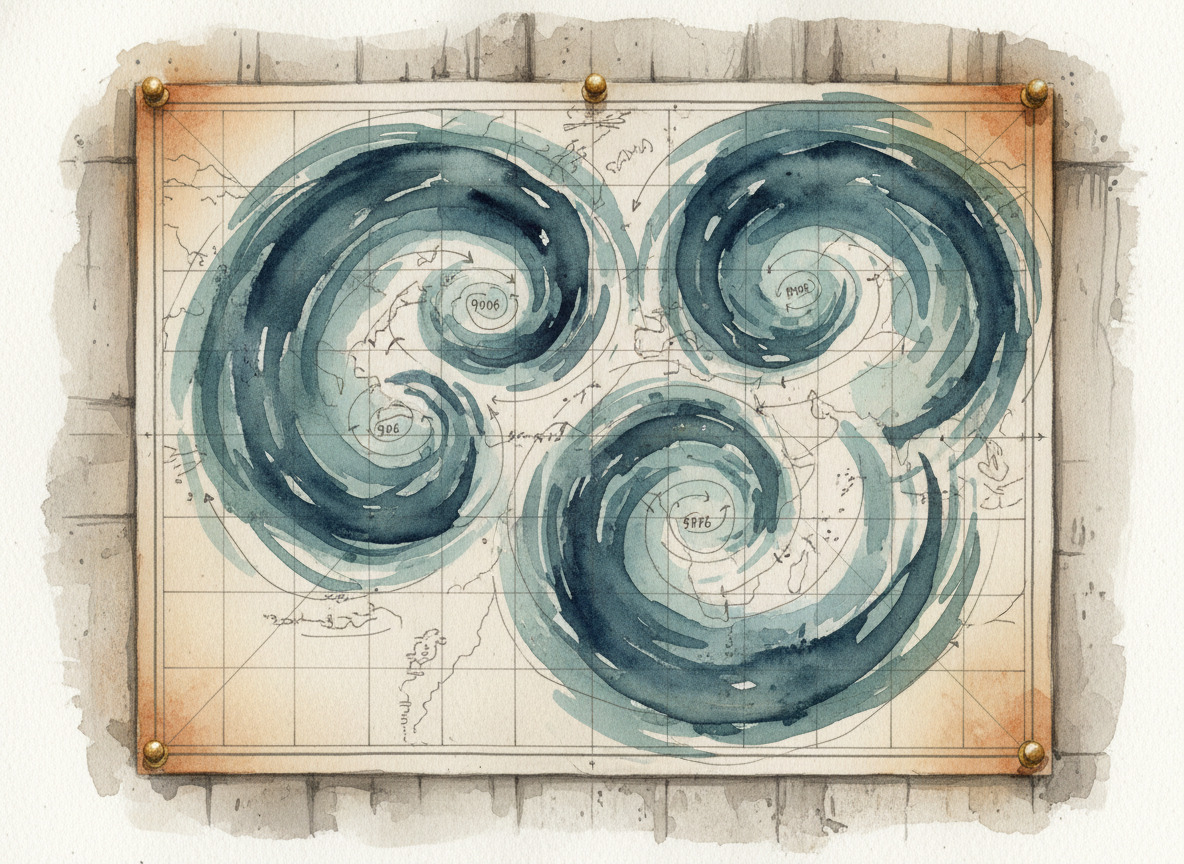 Three systems. One forecast nobody issued.
What struck me wasn't the storm itself. It was the convergence. Three systems, each survivable on its own, and nobody tracking the spot where they all meet.
The labor market data from the past year reminds me of that weather chart. U.S. companies announced 1.2 million job cuts in 2025, the highest since the pandemic. The fascinating part? AI was cited in just 4.5 percent of them.2
So what about the other 95 percent? Economy. Federal cuts. Companies closing. The familiar cold fronts. But this got me thinking. Harvard Business Review talked to a thousand executives around the world, and sixty percent said they'd already cut people because of what AI might do. Only two percent cut because of what it actually did.3
Imagine that for a second. Companies already under pressure to cut. That's the cold front. Then AI shows up, and suddenly there's a reason to do it now instead of next year. That's the warm air. In a better economy, those layoffs probably sit in a drawer somewhere. Instead, years of workforce changes got crammed into a few short months.
It wasn't just an American story, either. ASML in the Netherlands had record profits and still dropped 1,700 people. Bosch and the German automakers cut tens of thousands. Halfway around the world, Tata in India let go of 12,000 and Nissan in Japan, 11,000.4 Nobody planned this together. They didn't have to. The same weather was forming everywhere.
 Different cities. Different industries. Same weather.
Britain was the canary. Morgan Stanley found that UK companies lost eight percent of their jobs to AI in just one year. Twice the global average.5 British companies got roughly the same productivity boost from AI as American ones. But everything else was worse. Wages going up, taxes going up, growth going nowhere. Same technology, completely different outcome. It's like the same storm hitting two coastlines. It tears up the one where the seawall's already cracked.
I keep coming back to Bob Case and those six fishermen off Gloucester. They weren't killed by warm air or cold air or a hurricane. They were killed by the compound. All three arriving in the same water at the same time. Could it be that we're watching the same kind of convergence right now? Everyone's tracking AI as if it's the whole story. It's 4.5 percent of the story. The rest is everything else, arriving at once.
References
Footnotes
-
Wikipedia. "Perfect storm." Describes meteorologist Bob Case's analysis of the 1991 Halloween Nor'easter and Sebastian Junger's adoption of the phrase. Wikipedia ↩
-
CNBC. "AI was behind over 50,000 layoffs in 2025." Challenger, Gray & Christmas data on 1.17 million total U.S. job cuts and 55,000 attributed to AI. CNBC ↩
-
Davenport, T.H. and Mittal, N. (2026). "Companies Are Laying Off Workers Because of AI's Potential—Not Its Performance." Survey of 1,006 global executives on anticipatory vs. actual AI-driven headcount reductions. Harvard Business Review ↩
-
Global Finance Magazine. "AI, Tariffs Fuel Big Tech Layoffs." International layoff data including European manufacturers and Asia-Pacific firms. Global Finance ↩
-
Morgan Stanley research via Staffing Industry Analysts. "AI job cuts are landing hardest in Britain." UK net job losses, productivity comparisons, and labor market conditions. SIA ↩
More to Explore

How AI Hacks Humans
Google changes your settings every week. So when a scam asked a specialist to log in and change one, it sounded like work.

A Lived-In Language
The government tried to erase this language. Its speakers are still coining words.

The Endorsement
The government banned Anthropic's AI for being too dangerous. Every competitor's model is still running. That's not the compliment it sounds like for the competition.
Browse the Archive
Explore all articles by date, filter by category, or search for specific topics.
Open Field Journal