
The Trojan Combine
The 2026 Farm Bill pays farmers 90 cents on the dollar to adopt AI they didn't ask for, to replace workers they didn't choose to lose. The conservation budget got cut to fund it.

The Brief
The 2026 Farm Bill subsidizes AI adoption in agriculture at 90% while cutting the conservation program that funds it by a billion dollars. The same thing is happening in software. When the skill that defined you gets replaced by a platform, something deeper than productivity disappears.
- What does the 2026 Farm Bill do for precision agriculture?
- The 2026 Farm Bill reimburses farmers 90% of the cost of adopting AI and precision agriculture through EQIP, 15 points above the program's normal cap. The standards governing those technologies aren't set by the USDA. They're set by the tech industry. The same bill cuts EQIP's budget by over a billion dollars.
- Why are farmers being pushed to adopt AI right now?
- Immigration enforcement thinned the agricultural workforce, creating acute labor shortages. The Farm Bill's 90% cost-share for precision agriculture technology positions AI as the replacement. Farmers didn't choose the shortage, and with harvest deadlines and subsidized alternatives, the adoption isn't entirely voluntary.
- What is the identity cost of AI replacing skilled work?
- Skills used to define identity so deeply they became surnames: Smith, Cooper, Thatcher. When AI platforms absorb the decision-making that once required hands-on expertise, workers lose not just tasks but the basis for professional identity. Research shows the most anxious workers use AI the most, not because they've bought in, but because they're afraid of what happens if they don't.
- How does losing tacit knowledge affect future generations?
- Current practitioners can still fall back on traditional methods. But the next generation, trained entirely on AI-mediated workflows, may never develop the foundational knowledge needed to troubleshoot when systems fail. The concern applies equally to farmers who never learned to read soil and developers who never learned to read code.
The Trojan Horse worked because the Greeks had the decency to hide inside it. The 2026 Farm Bill doesn't bother. It covers 90% of the cost and lets farmers roll the thing through the gates themselves.
Your grandfather could fix the tractor. Your father could fix the tractor and run the GPS. You can run the GPS. Your kid can approve the recommendation the platform sends to their phone. Somewhere in that progression, someone stopped knowing why. Probably because the terms of service are written in Greek.
I've been checking into the Farm, Food, and National Security Act of 2026. One provision stopped me cold. Tucked inside the conservation title is a line that reimburses farmers 90% of the cost of adopting AI and precision agriculture technologies, 15 points above the normal cap.1 The same bill cuts the conservation program's budget by over a billion dollars.2 The bill lists GPS, yield monitors, and "Internet of Things and telematics technologies" right alongside cover crops and nutrient management.1 One of those categories involves a tractor. The rest involve a subscription.
And the standards governing these technologies? Not set by the USDA. By the tech industry itself. "Private sector-led interconnectivity standards, guidelines, and best practices," according to the bill's own language.1
The Hole and the Fix
The labor shortage driving this didn't materialize on its own. Immigration enforcement thinned the agricultural workforce, and now the government is subsidizing the replacement at 90 cents on the dollar. Nobody got to choose. When your crew disappears and someone covers the cost of the alternative, you take it. You have a harvest to bring in.
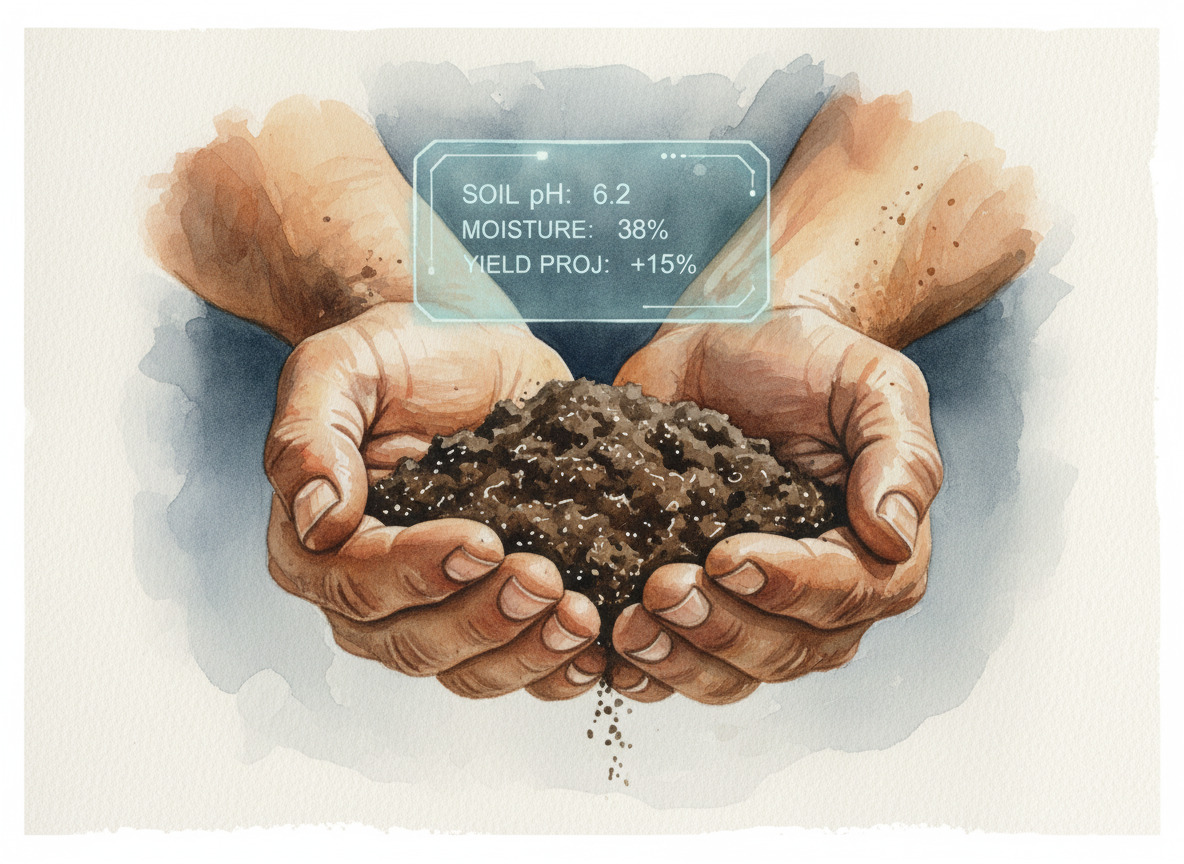 Ninety percent subsidy. Zero percent of the standards set by the people holding the dirt.
The Name on the Mailbox
I've been thinking about this from my own side of the fence. I write less code than I used to. I also produce more than I ever have. Both of those things are true at the same time, and the gap between them is where something important is disappearing.
When I wrote the code myself, I knew where to look when something broke. Not because I memorized it. Because my hands built it. That kind of intimacy with a system doesn't come from reviewing someone else's output. I approve code now the way a farmer might approve a planting recommendation from a platform. It's informed. It's reasonable. But I didn't arrive at it through seasons of watching that field.
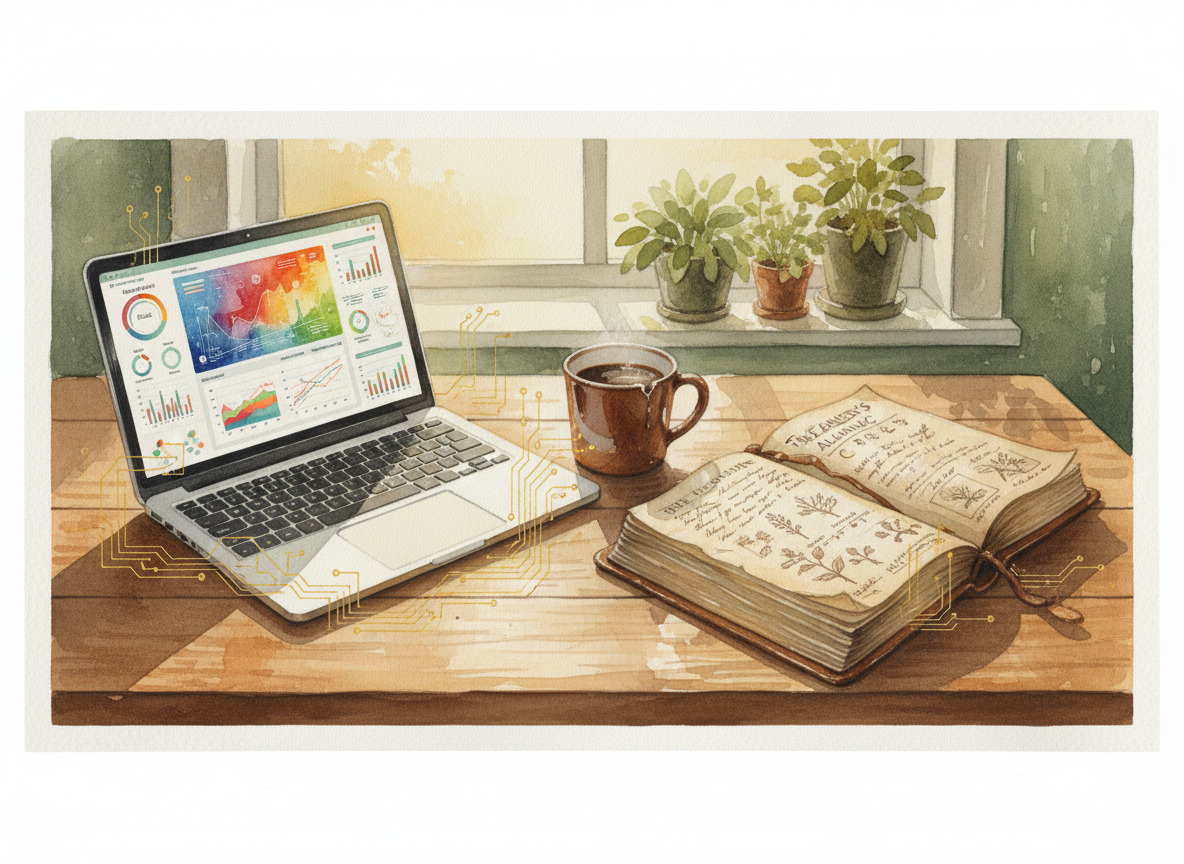 The almanac and the algorithm, side by side. One of them knows what the soil smelled like last spring.
In tech, I spent years complaining about opaque systems. Algorithms controlling decisions nobody could audit. Now I'm generating code I don't fully understand and shipping it to production. I became the thing I used to warn people about.
People used to be named for what they could do. Smith. Cooper. Thatcher. Weaver. The skill wasn't a job description. It was an identity. A recent study found that workers with the highest AI anxiety actually use AI more than their calm colleagues.3 Not because they've bought in. Because they're afraid of what happens if they don't. Usage isn't adoption. It's self-preservation. When you strip the skill away and replace it with a platform subscription, something deeper than productivity changes. A void opens up. And voids, in my experience, are always bad psychology.
The current generation of farmers can still call their fathers. Developers can still read the code by hand if they have to. But what about the generation after that? The one that never learned the old way because there was no reason to? When the platform goes down, the subscription lapses, or something happens that the training data never saw, who do they call?
Nobody's measuring that cost. It doesn't show up on a productivity dashboard. But it's the most expensive line item in the bill.
The Trojans didn't know what was inside the horse. This one comes with a label.
References
Footnotes
-
Pahnke, A. (2026). "The 2026 farm bill quietly hands big tech control over American farmland." Fortune ↩ ↩2 ↩3
-
National Sustainable Agriculture Coalition (2026). "At a Crossroads, House Farm Bill Falls Unmistakably Short." NSAC ↩
-
Ferrazzi, K. et al. (2026). "Why AI Adoption Stalls, According to Industry Data." Harvard Business Review ↩
More to Explore

How AI Hacks Humans
Google changes your settings every week. So when a scam asked a specialist to log in and change one, it sounded like work.

A Lived-In Language
The government tried to erase this language. Its speakers are still coining words.

The Endorsement
The government banned Anthropic's AI for being too dangerous. Every competitor's model is still running. That's not the compliment it sounds like for the competition.
Browse the Archive
Explore all articles by date, filter by category, or search for specific topics.
Open Field Journal