
The Two Indias
India attracted $200 billion in AI investment the same week its biggest tech firms added seventeen employees. Nobody on stage mentioned the gap.

The Brief
This article examines the contradiction at India's 2026 AI summit, where $200 billion in investment pledges arrived the same week India's five largest IT firms added only 17 net employees. It explores how capital-intensive AI infrastructure creates jobs for engineers and researchers while displacing the 1.65 million call-center workers who built India's first tech boom.
- How many employees did India's largest IT companies hire in 2025-2026?
- India's five largest IT companies added just 17 net employees in the first nine months of fiscal year 2025-2026, down from 17,764 the previous year. This near-zero hiring occurred despite massive AI investment flowing into the country, highlighting a disconnect between capital investment and workforce growth.
- How much AI investment was pledged at the India AI summit in 2026?
- At the 2026 India AI Impact Summit held at Bharat Mandapam in Delhi, major American AI companies including Anthropic, OpenAI, Google, Microsoft, and Meta collectively pledged $200 billion in investment. Microsoft alone committed $17.5 billion for cloud and AI infrastructure.
- What did Vinod Khosla say about IT services jobs in India?
- At the 2026 AI Impact Summit, venture capitalist Vinod Khosla predicted that by 2030 there will be no IT services or BPO industry. Former HCL Technologies CEO Vineet Nayar reinforced this, stating that believing AI investment would create employment is 'dreaming.'
- How many tech jobs could India lose to AI by 2031?
- According to India's NITI Aayog policy think tank, an inaction scenario could cost India 1.5 million tech jobs and up to 700,000 call-center positions by 2031. India currently has 1.65 million call-center workers and produces fewer than 500 AI PhDs per year.
- How are Indian workers reskilling for AI on their own?
- In Hyderabad's Ameerpet neighborhood, training centers formerly teaching Java and Microsoft Office now offer nine-month AI courses costing $1,360. Individual workers pay out of pocket, with no employer subsidies. The government's reskilling framework from the summit is voluntary and non-binding.
Every major American AI company flew to Delhi last week. Anthropic. OpenAI. Google. Microsoft. Meta. The Bharat Mandapam was packed. $200 billion in investment pledges. Sovereign language models trained from scratch. A signing ceremony for something called Pax Silica, a U.S.-led alliance to secure the global AI supply chain.1
The headlines were enormous. I kept reading. The number underneath was small. Seventeen.
India's five largest IT companies added 17 net employees in the first nine months of this fiscal year. Not seventeen thousand. Seventeen. The year before? 17,764.2
 $200 billion in commitments. Seventeen new hires.
Six weeks ago I wrote about a woman named Jennifer. She works the graveyard shift in Bangalore under an American name, solving billing problems for someone in Ohio at 2 AM. I wondered whether the humans in those jobs would get to change with them.
Last week offered one version of an answer. It depends which India you're asking about.
The investment India is real. Microsoft committed $17.5 billion for cloud and AI infrastructure alone. Indian startups unveiled language models trained from scratch in Indian languages using subsidized government compute.1 None of this is vapor.
But data centers are capital-intensive. They need engineers, not the 1.65 million people who staff call centers. Sovereign language models create jobs for AI researchers. India produces fewer than 500 AI PhDs a year.3
At the summit, Vinod Khosla was blunt. "By 2030 there will be no such things as IT services or BPO. Those are gone." Former HCL Technologies CEO Vineet Nayar was even more direct. "If you believe they are going to create employment, you must be dreaming."4
Same stage. Same week. Same city as the $200 billion number.
The summit did produce a reskilling framework. It was voluntary and non-binding. Meanwhile, in Hyderabad's Ameerpet neighborhood, training centers that used to teach Java and Microsoft Office now offer nine-month AI courses. The price is $1,360, paid by individual workers out of their own pockets.5
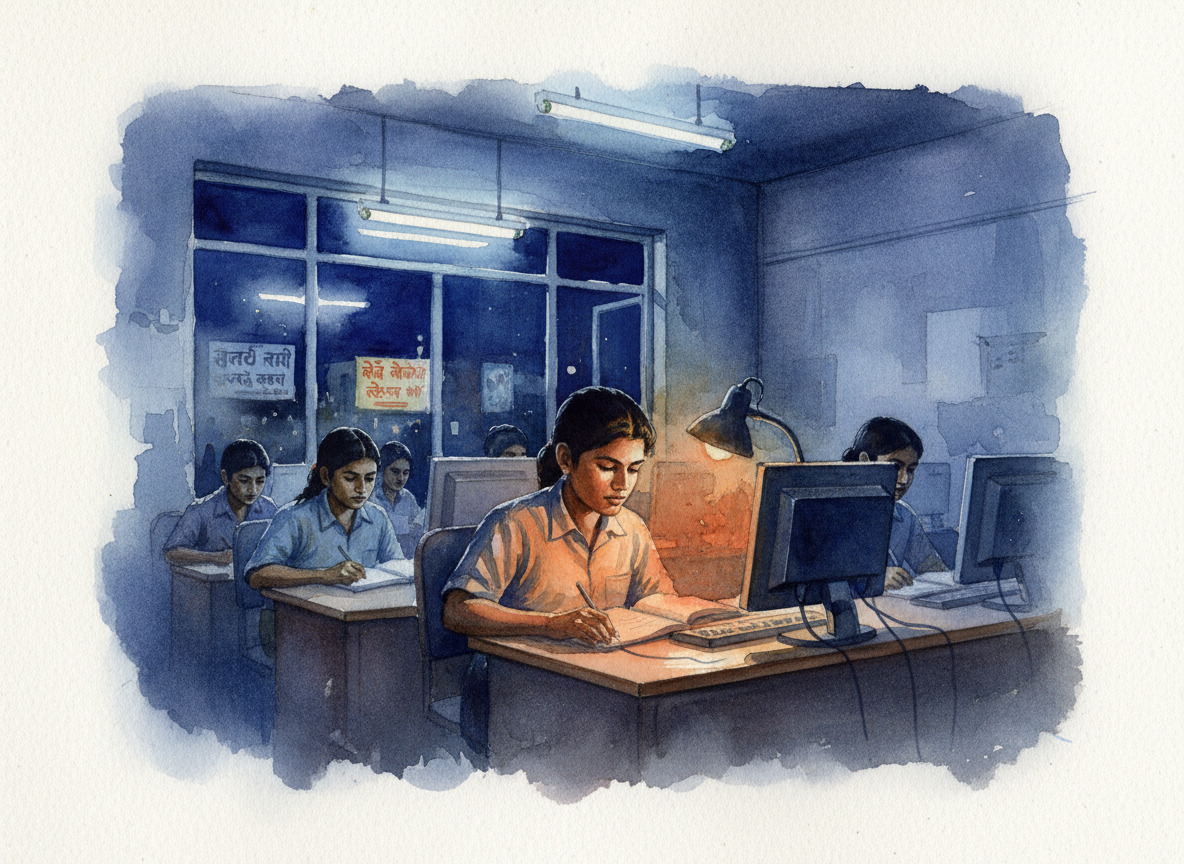 Nine months. $1,360. No employer picking up the tab.
India's own policy think tank modeled what happens if the bridge doesn't get built. By 2031, the inaction scenario loses 1.5 million tech jobs and up to 700,000 positions in the call centers where Jennifer works.3
Two numbers from the same week. $200 billion flowing in. Seventeen people hired. One India is building the future of AI. The other India built the industry that AI is replacing. And the gap between them isn't closing.
The summit ended. The CEOs flew home. Somewhere in Hyderabad, someone just paid $1,360 for a nine-month AI course, betting on themselves because nobody at the Bharat Mandapam bet on them. That's the India that built the first tech boom. It might have to build the bridge to the next one, too.
References
Footnotes
-
Chaudhuri, R. (2026). "Tech Is the Bright Spot in India-U.S. Relations." Foreign Policy ↩ ↩2
-
Computerworld. (2026). "AI Boom, Hiring Bust: Indian IT Firms Add Just 17 Net Employees in Nine Months." Computerworld ↩
-
NITI Aayog. (2025). "Roadmap for Job Creation in the AI Economy." NITI Aayog ↩ ↩2
-
India AI Impact Summit coverage. Khosla via Fortune India (2026). Nayar via Economic Times (2026). ↩
-
Reuters. (2025). "Meet the AI chatbots replacing India's call-center workers." Reuters ↩
More to Explore

How AI Hacks Humans
Google changes your settings every week. So when a scam asked a specialist to log in and change one, it sounded like work.

A Lived-In Language
The government tried to erase this language. Its speakers are still coining words.

The Endorsement
The government banned Anthropic's AI for being too dangerous. Every competitor's model is still running. That's not the compliment it sounds like for the competition.
Browse the Archive
Explore all articles by date, filter by category, or search for specific topics.
Open Field Journal